Art of Moving Points
Master Facial Articulation
A different approach to character facial articulation, taught through text, illustrations, and looping videos. Learn the Three Curve Principle, the math of 10, and how to move points in space with intent.
 By Brian Tindall
2-time VES award winner
By Brian Tindall
2-time VES award winner
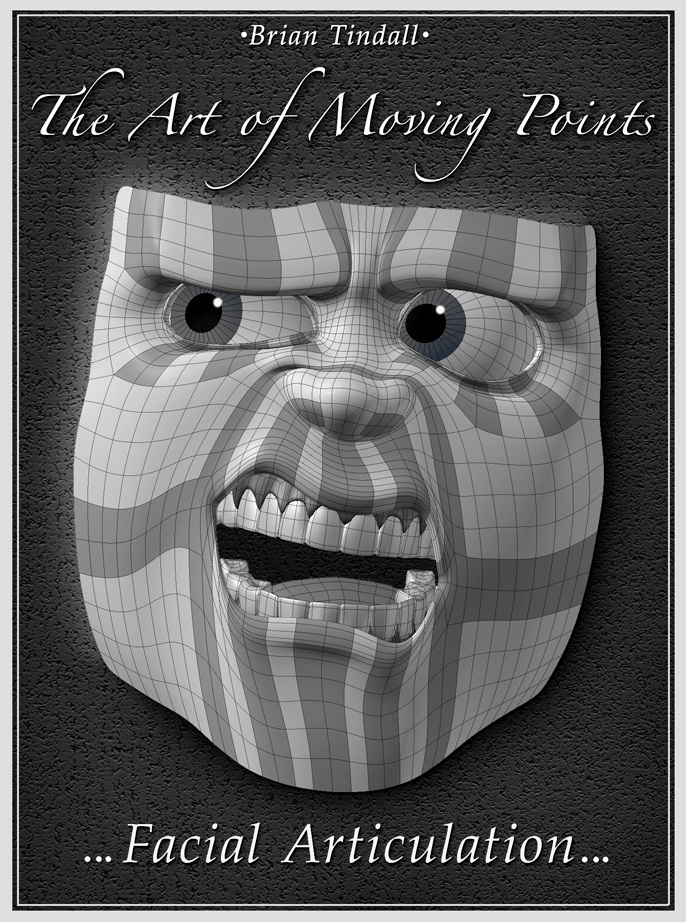
A different approach to facial articulation.
The Art of Moving Points focuses on the artistic side of bringing an animated character to life and teaches the foundation theories that go into the thought process of moving points in space.
This e-book is not about building a technical rig in a specific software package. It's about how point information adds up to create specific shapes on a character's face — the artistic decisions behind what an articulator actually does once a rig is in place.
Each chapter combines text, illustrations, looping reference videos, and interactive galleries so you can cross-reference visuals while you read. Articulation is hard to explain in text alone — this book is designed to teach the way artists actually learn.
The theory, the skills, who it's for, and why it works.
Articulation here isn't built on muscle simulation. It's built on landmarks, arcs, and overlapping action: the same Principles of Animation that drive performance. Switch tabs to move between the core theory, the practical skills you'll build, who and what's included, and why this approach matters.
The Three Curve Principle
Three curves combine into a foundation shape for each facial zone. Stack the zones together and you have a complete, controllable expression.
The Math of 10
A simple mathematical system gives your facial articulation repeatability and transferability, from one character to the next, regardless of shape.
Weighted Deformer + Sculpt
One deformer carries motion in a single axis. A macroed sculpt carries the volume. Movement and volume stay independently tunable, so your controls always add up.
Designing meshes for movement
Topology decisions that either help or fight every deformer you build later.
Breaking the face into zones
A landmark-based map of the face that scales from cartoon to photoreal characters.
Three Curve Principle & the math of 10
Foundation shapes that stay repeatable and transferable across characters.
Building point weight containers
Author and edit weight maps that drive your foundation deformers cleanly.
Assigning containers to deformers
Hook weights to deformers, set their Order of Operation, and balance them within and across zones.
Layering volume with sculpts
Add macroed sculpts on top of foundation deformers without losing your math.
Avars, controls & naming
Build animator-friendly controls and naming conventions that stay legible at production scale.
Articulating on arcs
Apply the Principles of Animation to articulation: arcs, overlapping action, and intent.
Built for working character artists. Everything in one $9.99 purchase — software-agnostic theory and a complete articulation system, delivered in your Ozone portal for life.
Who it's forRiggers, modelers & facial articulators
Intermediate-to-advanced character artists ready to push past standard joint and blendshape workflows into deformer-driven articulation.
Technical artists & pipeline TDs
Supporting character pipelines and looking to speak the same language as articulators and modelers.
Anyone going deeper on articulation
A theoretical framework, not a software tutorial, for working artists who learn best through visuals.
11 chapters · videos · galleries
Structured text, looping reference videos, and interactive image galleries you can cross-reference while you work.
Illustrated diagrams & deep dives
Diagrams layered onto 2D and 3D meshes plus text deep-dives on theory, naming conventions, and articulation logic.
Lifetime portal access
Sign in to portal.ozone3d.com any time. One purchase, your library is always there.
Software-agnostic. The book uses MODO by Luxology for examples because of how it lets you weight, evaluate, and reorder deformers independently. The theories transfer to any package that supports weight containers, deformers, and a defined Order of Operation.
Facial articulation is one of the hardest problems in character work. It's not just hard to do. It's hard to teach, because it sits at the intersection of the technical and the artistic. Most resources cover one side or the other. This e-book is about how artists actually think when they're moving points in space to bring a face to life.
If you've ever stared at a face rig and known something was off but couldn't name it, this is for you.
“The best solution to a mesh design and articulated character is the deadline you can meet.” Brian Tindall, from the preface
Eleven chapters. One unified articulation system.
Each chapter combines text, illustrations, looping videos, and interactive galleries. Open any chapter to read its summary.
01 Foundation Theory
02 Mesh Design for Movement
03 The Brow Zone
04 Eyes & Lids
05 The Cheek Zone
06 The Nose Zone
07 Mouth & Lips
08 The Jaw
09 Inner Mouth
10 Head & Neck
11 Layering Volume in Production
How the e-book actually reads.
Pages combine illustrated breakdowns, looping videos, and interactive galleries. Tap any image to bring it full-screen for cross-reference while you work.
Reading experience
Each chapter is laid out for working artists. Clean reading column, large reference images, and supporting context exactly where you need it.
Lip curl diagrams
Per-control breakdowns with annotated diagrams, looping videos, and side-by-side stages so you can study every articulation move.
Easy navigation & browsing
Quick-filter sidebar, chapter list, and the original cover front and center. Jump straight to the chapter, video, or gallery you need.
Everything you need…
Ready to start learning?
Get instant access to all 11 chapters, every video, every illustration, and every supporting file for a single $9.99 payment. No subscription. No expiration.
Get Access for $9.99
Quick answers.
Copyright & publishing
Copyright © 2013 by Brian Tindall. All rights reserved. No part of this publication may be reproduced, distributed, or transmitted in any form or by any means, including photocopying, recording, or other electronic or mechanical methods, without the prior written permission of the publisher, except in the case of brief quotations embodied in critical reviews and certain other noncommercial uses permitted by copyright law. For permission requests, write or email to the publisher, addressed “Attention: Permissions Request,” at the address below.
Hippydrome Publishing411 NE 61st Court
Hillsboro, OR 97124
www.hippydrome.com
ISBN-13: 978-0-9889372-0-8